Non-Dilutive Funding: Grant Strategies for US Biotech Startups 2025

Non-dilutive funding, particularly through strategic grants, provides US biotech startups with a vital avenue to advance their research and development in 2025 without equity dilution, thereby enhancing their financial impact and ensuring sustained growth.
For US biotech startups, securing capital is paramount to innovation and growth. However, the traditional path of equity financing often comes at the cost of ownership. This is where non-dilutive biotech funding, especially through strategic grants, emerges as a game-changer, offering a powerful alternative to fuel groundbreaking research and development in 2025 without relinquishing precious equity.
Understanding Non-Dilutive Funding for Biotech
Non-dilutive funding refers to capital received that does not require the relinquishment of equity or ownership in a company. For biotech startups, this distinction is critical. Unlike venture capital or angel investments, non-dilutive funds, primarily grants, allow founders to maintain full control over their intellectual property and strategic direction. This preservation of ownership can be invaluable in the early, high-risk stages of drug discovery and development.
The appeal of non-dilutive funding extends beyond equity retention; it often comes with fewer strings attached regarding operational control compared to equity investors. This flexibility empowers startups to focus solely on their scientific objectives and business milestones. Moreover, successful grant acquisition can serve as a strong validation of a startup’s scientific merit, attracting further investment and partnerships down the line.
Key Advantages of Non-Dilutive Capital
For budding biotech ventures, non-dilutive capital offers several distinct advantages that can significantly impact their trajectory.
- Equity Preservation: Founders retain complete ownership and control of their company.
- Validation and Credibility: Grant awards signal external validation of scientific rigor and potential.
- Reduced Pressure: Less immediate pressure to achieve rapid commercialization, allowing focus on foundational research.
- Catalyst for Further Investment: A strong grant portfolio can make a startup more attractive to future equity investors.
In essence, non-dilutive funding acts as a strategic cornerstone, providing the necessary financial runway for biotech startups to navigate the complex and capital-intensive journey from concept to clinic. It’s about smart growth, ensuring that scientific breakthroughs are not hampered by premature equity dilution.
Navigating Federal Grant Opportunities in 2025
The US federal government remains a prolific source of non-dilutive funding for biotech, particularly through agencies like the National Institutes of Health (NIH) and the Small Business Innovation Research (SBIR) and Small Business Technology Transfer (STTR) programs. These programs are specifically designed to support small businesses engaged in research and development with commercial potential. Understanding their nuances is key to successful applications in 2025.
The NIH, for example, funds a vast spectrum of biomedical research, from basic science to clinical trials. Their grant mechanisms, such as R01s, R21s, and various small business awards, cater to different stages of development and research scope. Applicants must meticulously align their proposals with the specific interests and priorities of relevant NIH institutes and centers.
The SBIR/STTR Programs: A Biotech Lifeline
The SBIR and STTR programs, often referred to as ‘America’s Seed Fund,’ are cornerstone programs for biotech startups. They provide non-dilutive funds for R&D that has the potential for commercialization. SBIR focuses on small businesses, while STTR requires a formal collaboration with a research institution.
- Phase I: Up to $250,000 for proof-of-concept research, typically lasting 6-12 months.
- Phase II: Up to $1.75 million for full-scale R&D, lasting 2 years, building on Phase I success.
- Phase III: Commercialization of the innovation, often without federal funding, but leveraging prior phases.
Other federal agencies, such as the Department of Defense (DoD) and the National Science Foundation (NSF), also offer grants relevant to biotech, particularly for technologies with dual-use potential or foundational scientific breakthroughs. Staying informed about their annual solicitations and specific research interests is crucial for maximizing opportunities. Success in federal grants hinges on a compelling scientific narrative, a strong management team, and a clear path to commercialization.
State-Level and Regional Grant Initiatives
Beyond federal programs, a rich landscape of state-level and regional grant initiatives exists within the US, offering tailored support for biotech startups. These programs often target specific regional economic development goals, fostering innovation within local ecosystems. Identifying and leveraging these geographically specific opportunities can provide a significant boost for emerging biotech companies.
Many states with strong biotech hubs, such as California, Massachusetts, North Carolina, and Maryland, have established dedicated funding programs. These can range from direct grants for R&D, matching funds for federal awards, to tax credits for innovation. These programs are often administered by state economic development agencies, university systems, or specialized non-profit organizations focused on life sciences.
Examples of State Support for Biotech
Each state’s approach to supporting biotech can vary, but common themes include fostering collaboration, accelerating commercialization, and creating high-value jobs.
- California’s CIRM: The California Institute for Regenerative Medicine provides significant funding for stem cell and regenerative medicine research.
- Massachusetts Life Sciences Center: Offers grants, loans, and tax incentives to support life sciences companies and research institutions.
- North Carolina Biotechnology Center: Provides grants for early-stage research, technology development, and commercialization.
These state-specific grants often have less intense competition than federal programs and can be more accessible for very early-stage companies. They also provide valuable networking opportunities with local industry leaders and academic institutions. Biotech startups should actively research and engage with their state and regional economic development offices to discover these localized funding avenues, which can be pivotal for early growth.
Private Foundations and Non-Profit Organizations
Private foundations and non-profit organizations represent another critical pillar of non-dilutive funding for US biotech startups. These entities often have specific missions, focusing on particular disease areas, scientific challenges, or patient populations. Aligning a startup’s research with a foundation’s mission can unlock substantial funding and strategic partnerships.
Unlike government grants, which can be broad, foundation grants are typically highly targeted. This means that while the application process might still be rigorous, the chances of success can be higher if a startup’s work perfectly matches the foundation’s objectives. Many foundations are also keen to see a clear path to patient impact, making them ideal partners for biotech companies developing novel therapies or diagnostic tools.
Identifying and Engaging with Key Foundations
Success in securing funding from private foundations requires diligent research and a tailored approach. Startups should identify foundations whose funding priorities directly align with their scientific focus.
- Disease-Specific Foundations: Organizations like the Michael J. Fox Foundation for Parkinson’s Research or the Cystic Fibrosis Foundation are major funders in their respective areas.
- General Science Foundations: Larger foundations, such as the Gates Foundation or the Kavli Foundation, may fund broader scientific endeavors that encompass biotech.
- Patient Advocacy Groups: Many patient groups actively fund research aimed at finding cures or improving treatments for specific conditions.
Engaging with these foundations often involves more than just submitting a proposal; it can include attending their sponsored events, networking with their program officers, and demonstrating a genuine commitment to their mission. Building relationships can significantly enhance a startup’s chances of securing funding and gaining valuable advisory support.
Crafting a Winning Grant Proposal
Securing non-dilutive funding, especially through grants, is highly competitive. A well-crafted grant proposal is not just a scientific document; it’s a persuasive narrative that articulates the problem, presents a compelling solution, and outlines a clear path to impact. For US biotech startups in 2025, mastering the art of grant writing is an indispensable skill.
The foundation of any strong grant proposal is scientific merit. This includes presenting robust preliminary data, a clear hypothesis, and a meticulously designed experimental plan. However, beyond the science, funding agencies and foundations are looking for innovation, feasibility, and a strong potential for commercialization or patient benefit. The proposal must clearly communicate why this particular project should be funded over others.
Essential Components of a Strong Proposal
While specific requirements vary by grant, several core elements are universally critical for a winning submission.
- Executive Summary: A concise, compelling overview that captures the essence of the project.
- Specific Aims: Clearly defined, measurable objectives that the research will address.
- Significance: Explaining the importance of the problem and the potential impact of the proposed solution.
- Innovation: Highlighting how the proposed research pushes the boundaries of current knowledge or technology.
- Approach: A detailed experimental plan, including methods, timelines, and anticipated results.
- Team and Resources: Demonstrating the expertise of the research team and the adequacy of available resources.
- Commercialization Plan: For SBIR/STTR, a robust plan outlining how the innovation will reach the market.
Beyond these technical components, attention to detail, adherence to guidelines, and clear, concise writing are paramount. Peer review is a cornerstone of most grant processes, meaning proposals must be accessible and convincing to a broad scientific audience. Seeking feedback from mentors and experienced grant writers before submission can significantly improve a proposal’s chances of success.
Strategic Implementation and Financial Impact
Successfully acquiring non-dilutive funding is only half the battle; strategically implementing these funds to maximize financial impact is equally vital for US biotech startups. This involves meticulous financial planning, efficient resource allocation, and a clear understanding of how grant funds integrate into the broader business strategy. In 2025, startups must demonstrate not just scientific prowess but also fiscal responsibility and strategic foresight.
Grant funds should be viewed as a catalyst for achieving specific milestones, not merely as operating capital. Each grant should be tied to a clear set of objectives, whether it’s advancing a preclinical candidate, validating a new technology, or securing intellectual property. This targeted approach ensures that the funds directly contribute to de-risking the technology and increasing the company’s valuation without equity dilution.
Maximizing Grant ROI
To maximize the return on investment (ROI) from non-dilutive funds, startups should consider several strategic approaches.
- Leveraging for Follow-on Funding: Use initial grant success to attract larger grants or equity investments.
- Building Internal Capabilities: Invest in key personnel, equipment, and infrastructure that will serve long-term R&D goals.
- Intellectual Property Development: Strategically use funds to strengthen patent portfolios and protect innovations.
- Strategic Partnerships: Grants can facilitate collaborations with academic institutions or larger pharmaceutical companies.
Moreover, maintaining transparent financial records and adhering strictly to grant reporting requirements are non-negotiable. This not only ensures compliance but also builds a reputation for trustworthiness and accountability, which can be beneficial for future funding endeavors. Ultimately, the financial impact of non-dilutive funding is measured not just by the dollars received, but by how effectively those dollars propel the startup towards its scientific and commercial goals, all while preserving equity.
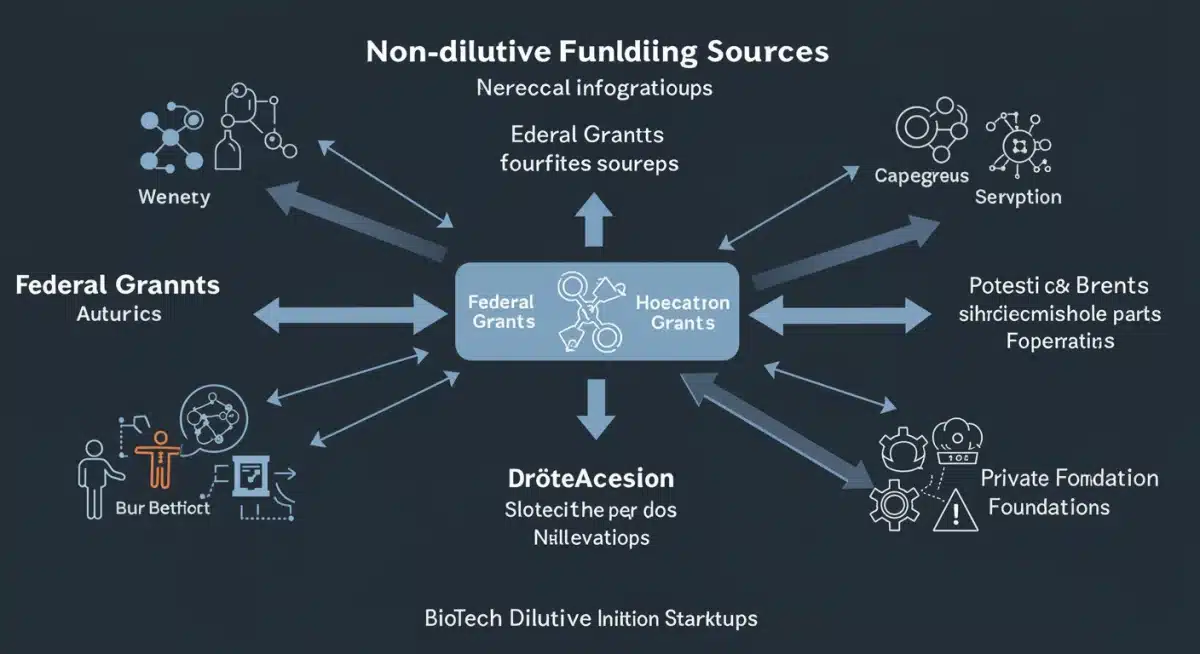
| Key Funding Source | Brief Description & Benefit |
|---|---|
| Federal Grants (NIH, SBIR/STTR) | Significant non-dilutive capital for R&D; strong validation of scientific merit; multi-phase funding opportunities. |
| State & Regional Programs | Tailored support for local biotech ecosystems; less competition; fostering regional economic growth. |
| Private Foundations | Mission-driven funding for specific disease areas or scientific challenges; potential for strategic partnerships. |
| Strategic Grant Writing | Crucial for success; requires clear scientific merit, innovation, feasibility, and a strong commercialization plan. |
Frequently Asked Questions About Non-Dilutive Biotech Funding
Non-dilutive funding is capital that doesn’t require a startup to give up equity. It’s crucial for biotech because it allows founders to retain ownership and control, preserving the company’s valuation and strategic direction while funding expensive research and development.
The main federal sources include the National Institutes of Health (NIH) and the Small Business Innovation Research (SBIR) and Small Business Technology Transfer (STTR) programs. Agencies like the Department of Defense (DoD) and the National Science Foundation (NSF) also offer relevant grants.
State-level grants are often more localized and less competitive, targeting specific regional economic development goals. They can be easier for very early-stage companies to secure and provide valuable local networking, complementing broader federal programs.
Private foundations provide highly targeted funding, often focused on specific disease areas or scientific challenges. They are excellent partners for biotech companies whose research aligns with the foundation’s mission, offering significant funding and strategic advisory support.
A successful proposal requires strong scientific merit, clear specific aims, demonstrated significance and innovation, a detailed approach, and a capable team. For SBIR/STTR, a robust commercialization plan is also essential, all presented with clarity and adherence to guidelines.
Conclusion
For US biotech startups in 2025, mastering the landscape of non-dilutive funding, particularly through strategic grant acquisition, is not merely an option but a strategic imperative. By leveraging federal, state, and private foundation grants, companies can secure the vital capital needed to propel their innovative research and development forward without sacrificing equity. This approach not only safeguards ownership and control but also provides critical validation, opens doors to further investment, and ultimately maximizes the financial impact of every scientific breakthrough. A proactive, well-researched, and expertly executed grant strategy will be the cornerstone of sustained growth and success in the competitive biotech arena.