Biotech Patent Expirations 2026: Investor Guide
The biotechnology and pharmaceutical sectors are perpetually in motion, driven by innovation, research, and the intricate web of intellectual property. For investors, understanding the dynamics of this landscape is not just beneficial; it’s absolutely essential. Among the most significant factors influencing valuations, market share, and future profitability are biotech patent expirations. As we approach 2026, a critical juncture looms, promising to reshape the competitive environment for numerous blockbuster drugs.
This comprehensive guide aims to equip investors with the knowledge and foresight necessary to navigate the impending wave of biotech patent expirations in 2026. We will delve into the profound implications for both innovator companies and generic drug manufacturers, explore the rise of biosimilars, and offer strategic insights to protect and potentially grow your capital in this evolving market.
The Significance of Biotech Patent Expirations for Investors
Patents are the lifeblood of the pharmaceutical and biotechnology industries. They grant innovator companies exclusive rights to manufacture, sell, and profit from their discoveries for a finite period, typically 20 years from the patent’s filing date. This exclusivity allows companies to recoup their substantial research and development investments, which can often run into billions of dollars for a single drug, and to generate profits that fund future innovation.
However, once a patent expires, the competitive landscape shifts dramatically. Generic and biosimilar manufacturers can enter the market with their versions of the drug, often at significantly lower prices. This immediate influx of competition can lead to a rapid erosion of market share and revenue for the original innovator company.
Understanding the Patent Cliff
The term "patent cliff" refers to the period when a significant number of blockbuster drugs lose their patent protection, leading to a sharp decline in sales for the original manufacturers. We’ve witnessed several patent cliffs in the past, and 2026 is poised to be another pivotal year for the biotech sector, with several high-revenue drugs facing the end of their exclusivity.
For investors, the patent cliff presents both substantial risks and intriguing opportunities. Companies heavily reliant on drugs nearing patent expiration may see their stock prices suffer, while generic and biosimilar manufacturers poised to enter these markets could experience significant growth. Strategic investors must therefore meticulously track upcoming biotech patent expirations to make informed decisions.
Key Biotech Drugs Facing Patent Expiration in 2026
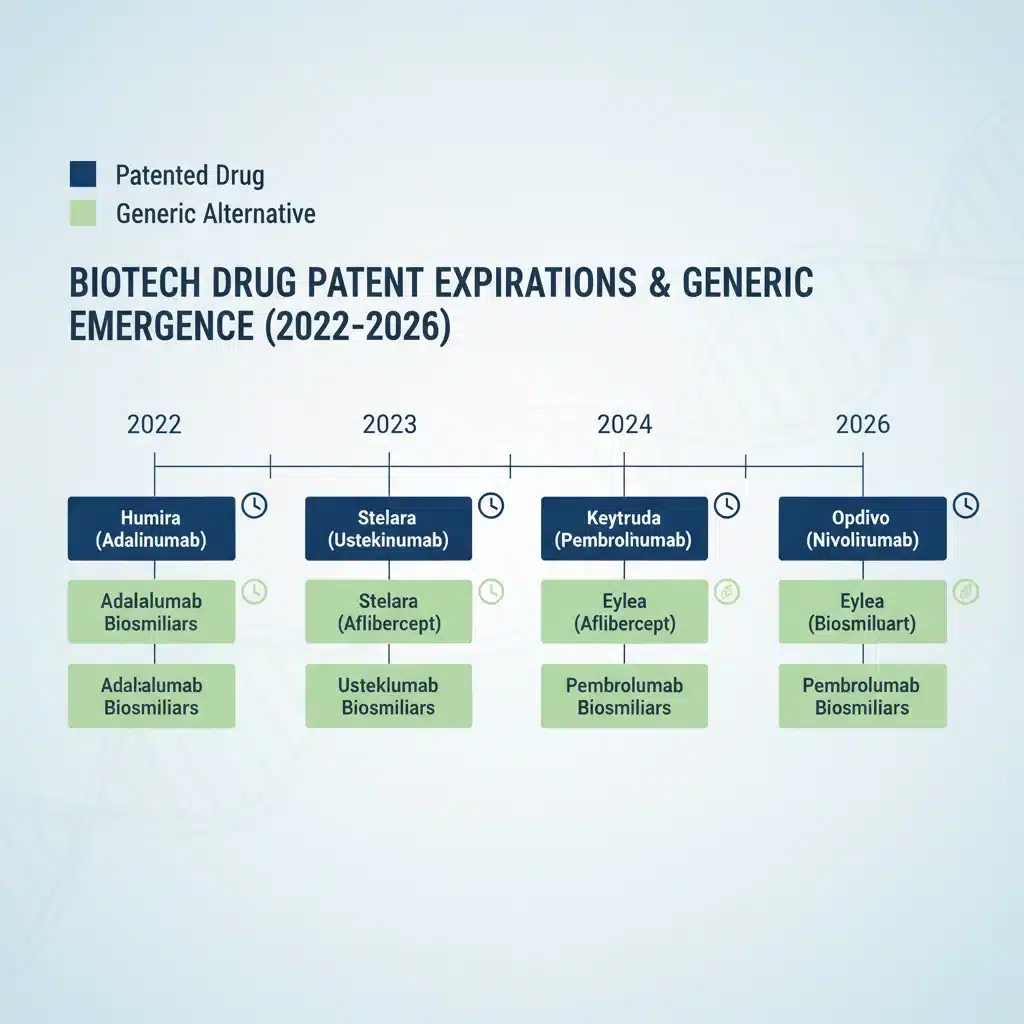
While the exact list of drugs facing patent expiration can be fluid due to extensions, litigation, and new patents, several high-profile biotech products are currently projected to lose exclusivity around 2026. These include treatments for various conditions, from autoimmune diseases and cancer to metabolic disorders.
It’s crucial for investors to conduct their own due diligence, but some of the prominent drug classes and specific molecules to watch include:
- Biologics: Many complex biologic drugs, which are often more challenging to replicate than small-molecule drugs, will see their patents expire. This opens the door for biosimilar competition.
- Oncology Treatments: Several high-revenue cancer therapies may face generic or biosimilar competition, potentially altering treatment landscapes and market dynamics.
- Autoimmune Disease Therapies: Drugs treating conditions like rheumatoid arthritis, psoriasis, and Crohn’s disease, which often have high price tags, are also on the watch list.
The impact of these expirations will not be uniform. Factors such as the drug’s market size, the complexity of its manufacturing, the number of potential generic/biosimilar entrants, and the innovator company’s strategies to mitigate losses will all play a role.
The Rise of Biosimilars: A New Dynamic
Unlike traditional generic drugs, which are exact chemical copies of small-molecule drugs, biosimilars are highly similar, but not identical, versions of biologic drugs. Biologics are complex molecules derived from living organisms, making them much more challenging to manufacture and characterize. While not exact replicas, biosimilars must demonstrate high similarity in terms of structure, function, and clinical efficacy to their reference product.
The regulatory pathway for biosimilars is more rigorous than for generics, often requiring extensive clinical trials to prove interchangeability or similarity. Despite these hurdles, the entry of biosimilars has proven to be a significant cost-saver for healthcare systems and a major competitive threat to innovator biologic manufacturers.
Why Biosimilars Matter for 2026
Many of the blockbuster drugs facing biotech patent expirations in 2026 are biologics. This means that the primary form of post-patent competition will come from biosimilars. Investors need to understand the nuances of the biosimilar market:
- Market Penetration: Biosimilar uptake can be slower than generic uptake due to physician and patient hesitations, as well as complex reimbursement policies.
- Pricing Strategies: Biosimilars typically offer price reductions of 15-30% compared to the reference biologic, less steep than the 80-90% reductions seen with small-molecule generics.
- Manufacturing Expertise: Developing and manufacturing biosimilars requires significant scientific and technical expertise, limiting the number of potential entrants compared to generics.
Companies with strong biosimilar development pipelines and manufacturing capabilities are well-positioned to capitalize on the 2026 patent expirations. Conversely, innovator companies with biologics going off-patent must have robust strategies in place to defend their market share.
Impact on Innovator Pharmaceutical Companies
For pharmaceutical companies whose drugs are losing patent protection, the challenges are significant. Revenue erosion can be substantial, impacting profitability, R&D budgets, and ultimately, stock performance. However, savvy innovator companies employ various strategies to mitigate the "patent cliff" effect:
Life Cycle Management Strategies
Innovator companies don’t passively await patent expiration. They actively engage in life cycle management to extend the commercial viability of their products:
- New Formulations or Delivery Methods: Developing new versions of the drug (e.g., extended-release, different administration routes) can secure new patents and offer patients benefits, potentially shifting market preference.
- New Indications: Seeking regulatory approval for the drug in additional diseases or conditions can open up new markets and extend exclusivity.
- Combination Therapies: Combining the expiring drug with another patented compound can create a new, protected product.
- "Evergreening" Strategies: While sometimes controversial, companies may seek to extend patent protection through minor modifications or new patents on manufacturing processes.
- Authorized Generics/Biosimilars: Some innovator companies launch their own generic or biosimilar versions of their drug, often through a subsidiary, to capture a portion of the post-patent market.
Diversification and Pipeline Strength
The most robust defense against patent expirations is a strong and diversified pipeline of new drugs. Companies with multiple promising candidates in late-stage clinical trials are better equipped to offset revenue losses from expiring patents. Investors should scrutinize the R&D pipeline of companies with significant 2026 patent exposure.
Opportunities for Generic and Biosimilar Manufacturers
While patent expirations pose challenges for innovators, they represent immense opportunities for generic and biosimilar manufacturers. These companies thrive on bringing lower-cost alternatives to market, increasing access for patients and generating significant revenue for themselves.
Competitive Advantages of Generics/Biosimilars
- Lower Development Costs: Generic and biosimilar development costs are a fraction of the cost of developing an original innovator drug, as they do not need to repeat extensive preclinical and clinical trials.
- Rapid Market Entry: Once regulatory approval is secured, these companies can often launch quickly, especially if they have manufacturing capacity ready.
- Price Sensitivity: Healthcare systems and payers are increasingly seeking cost-effective drug options, creating a strong demand for generics and biosimilars.
Investors interested in this segment should look for companies with a proven track record in regulatory submissions, strong manufacturing capabilities, and a robust portfolio of drugs targeting upcoming biotech patent expirations.
Investment Strategies for the 2026 Biotech Patent Landscape
Navigating the 2026 patent cliff requires a well-thought-out investment strategy. Here are several approaches investors can consider:
1. Due Diligence on Innovator Companies
For companies with drugs losing patent protection, assess their:
- Pipeline Strength: How many drugs are in late-stage development? What is their potential market size?
- Life Cycle Management: Are there new formulations, indications, or combination therapies in the works?
- Financial Health: How strong is their balance sheet? Can they absorb potential revenue losses?
- Geographic Diversification: Are they reliant on a single market, or do they have a global presence that might buffer losses?
2. Identifying Promising Generic/Biosimilar Players
Look for companies that are actively developing and seeking approval for generics or biosimilars of drugs expected to lose patent protection in 2026. Key factors to consider include:
- Regulatory Expertise: A history of successful FDA/EMA approvals for generics/biosimilars.
- Manufacturing Capacity: The ability to produce large volumes efficiently and cost-effectively.
- Portfolio Breadth: Companies with a diverse pipeline of generic/biosimilar candidates are less reliant on the success of a single product.
- Strategic Partnerships: Collaborations with larger pharmaceutical companies can provide access to resources and market channels.
3. Diversification Across the Biotech Sector
Rather than concentrating investments in a few companies directly impacted by patent expirations, consider diversifying across different segments of the biotech sector. This could include:
- Biotech ETFs/Mutual Funds: These can provide broad exposure and mitigate company-specific risks.
- Early-Stage Biotech: Companies focused on novel drug discovery or platform technologies that are not yet facing patent expiry concerns.
- Contract Research Organizations (CROs) and Contract Manufacturing Organizations (CMOs): These service providers benefit from increased R&D across the industry, regardless of individual drug patent status.
4. Monitoring Legal and Regulatory Developments
Patent litigation is common in the pharmaceutical industry. Lawsuits challenging patent validity or seeking extensions can significantly alter the timeline of biotech patent expirations. Investors should stay informed about major legal battles and regulatory decisions that could impact drug exclusivity.
5. Focusing on "Beyond-the-Pill" Strategies
Some innovator companies are investing in digital health solutions, patient support programs, and integrated care models that go beyond the drug itself. These "beyond-the-pill" strategies can create new revenue streams and differentiate products even after patent expiration.
Case Studies from Past Patent Expirations
Examining historical examples of patent expirations can offer valuable lessons. The entry of biosimilars for drugs like Humira (adalimumab) in the US in 2023, while beyond our 2026 scope, provides a recent example of how complex the biosimilar market can be, with multiple entrants and varying pricing strategies. Similarly, the impact of generic competition on small-molecule blockbusters like Lipitor (atorvastatin) or Plavix (clopidogrel) demonstrated the rapid and significant revenue erosion innovator companies can face.
These cases highlight the importance of:
- Pre-emptive Action: Innovators who prepare well in advance fare better.
- Market Dynamics: The number of generic/biosimilar entrants directly correlates with price erosion.
- Payer Influence: Insurance companies and national health systems play a crucial role in driving generic/biosimilar uptake.
The Role of Government Policy and Healthcare Reform
Government policies and healthcare reforms also play a significant role in shaping the impact of biotech patent expirations. Initiatives aimed at lowering drug costs, such as encouraging generic and biosimilar competition, can accelerate market penetration and price erosion. Investors should monitor legislative and regulatory changes in key markets (e.g., the US, EU, Japan) that could influence the competitive landscape.
For instance, policies that streamline the approval process for biosimilars or mandate their use in certain settings can significantly boost their market share. Conversely, policies that offer additional exclusivity periods for certain drug categories or orphan drugs can extend patent protection.
Challenges and Risks to Consider
While opportunities abound, investors must also be aware of the inherent risks:
- Litigation Risks: Patent litigation can be unpredictable, with outcomes potentially delaying generic/biosimilar entry or invalidating existing patents.
- Regulatory Delays: The approval process for generics and biosimilars can face delays, impacting launch timelines.
- Manufacturing Complexities: Especially for biosimilars, manufacturing challenges can lead to supply issues or quality concerns.
- Market Acceptance: Physician and patient acceptance of new generics or biosimilars is not always immediate.
- Innovator Counter-Strategies: Aggressive pricing, authorized generics, or rebate programs from innovator companies can limit the profitability of new entrants.

Conclusion: Navigating the 2026 Biotech Patent Landscape
The year 2026 represents a significant milestone in the biotech and pharmaceutical industries, marked by a wave of biotech patent expirations that will undoubtedly reshape market dynamics. For investors, this period is not merely a challenge but a complex interplay of risks and opportunities.
Successful navigation requires a deep understanding of patent law, regulatory pathways for generics and biosimilars, and the strategic responses of both innovator and challenger companies. By conducting thorough due diligence, diversifying portfolios, and staying abreast of legal and market developments, investors can position themselves to not only mitigate potential losses but also to capitalize on the emerging opportunities in this dynamic sector.
The future of biotech investing demands vigilance and adaptability. As the industry continues its relentless pursuit of innovation, the cycle of patent protection and expiration will remain a central theme, dictating fortunes and fostering continuous evolution. Be prepared, be informed, and strategically position your investments for the changes that 2026 will bring.