Gene Editing Technologies: Investor’s Guide to 2026 Growth

The top three gene editing technologies poised for explosive growth by mid-2026 are CRISPR-Cas9, Base Editing, and Prime Editing, offering unprecedented opportunities for investors seeking high-impact biotech ventures.
Are you ready to unlock the future of medicine and potentially significant returns? This comprehensive investor’s guide delves into the top 3 gene editing technologies poised for explosive growth by mid-2026: An Investor’s Guide. We will explore the revolutionary potential of CRISPR-Cas9, the precision of Base Editing, and the versatility of Prime Editing, offering crucial insights for those looking to make informed decisions in the dynamic biotech landscape.
Understanding the Gene Editing Revolution
Gene editing represents one of the most profound scientific advancements of our time, offering the ability to precisely modify DNA sequences. This capability unlocks new avenues for treating genetic diseases, enhancing agricultural crops, and even developing novel diagnostics. For investors, understanding the core principles behind these technologies is paramount to identifying promising opportunities.
The field is characterized by rapid innovation and a competitive landscape, with new discoveries constantly refining existing methods and introducing groundbreaking approaches. Early investors in companies leveraging these technologies stand to benefit significantly as these innovations transition from research labs to clinical applications and commercial products.
The promise of genomic medicine
Genomic medicine is no longer a distant dream but a rapidly approaching reality, fueled by advancements in gene editing. This paradigm shift promises highly personalized treatments that address the root cause of diseases at a genetic level. The potential impact on human health is immense, ranging from curing inherited disorders to developing more effective cancer therapies.
- Targeting previously untreatable genetic conditions.
- Developing personalized cancer immunotherapies.
- Preventing disease by correcting predispositions.
- Improving diagnostic accuracy and speed.
The regulatory environment, while stringent, is also evolving to accommodate these novel therapies, creating clearer pathways for clinical trials and market approval. This maturation of the regulatory landscape provides a more predictable investment climate for innovative biotech firms.
In conclusion, the gene editing revolution is not just a scientific marvel but a significant economic force. Its ability to reshape medicine and agriculture positions it as a cornerstone of future investment portfolios. Grasping the fundamentals of this revolution is the first step towards identifying the next big biotech success story.
CRISPR-Cas9: The Pioneer and Its Evolving Landscape
CRISPR-Cas9, often simply referred to as CRISPR, burst onto the scene as a revolutionary gene-editing tool, democratizing genetic manipulation and accelerating research across various biological fields. Its mechanism, derived from a bacterial immune system, allows for precise cuts in DNA, enabling scientists to remove, insert, or alter specific genes. This groundbreaking technology has already paved the way for numerous clinical trials and significant investment.
While CRISPR-Cas9 remains a dominant force, the technology is continuously being refined. Researchers are exploring ways to improve its specificity, reduce off-target effects, and expand its delivery methods to various tissues and organs. These ongoing innovations are critical for its broader therapeutic application and continued market growth.
Current applications and future potential
CRISPR’s applications span a wide range, from treating blood disorders like sickle cell disease and beta-thalassemia to combating various forms of cancer. Its ability to directly modify the human genome offers hope for conditions previously deemed incurable. Looking ahead, CRISPR is expected to play a pivotal role in areas such as neurodegenerative diseases, infectious diseases, and even in developing enhanced regenerative medicines.
- Treatment of genetic blood disorders.
- Development of novel cancer therapies.
- Research into HIV and other infectious diseases.
- Potential for agricultural advancements and disease resistance.
The market for CRISPR-related technologies is projected to grow substantially, driven by continued research, increasing clinical pipeline, and expanding intellectual property portfolios. Investors should closely monitor companies with strong patent positions and robust clinical development programs.
In essence, CRISPR-Cas9 is more than just a scientific tool; it’s a platform technology with an ever-expanding horizon of applications. Its foundational role in gene editing ensures its continued relevance and growth as the biotech industry progresses towards more targeted and effective therapies.
Base Editing: Precision Beyond the Cut
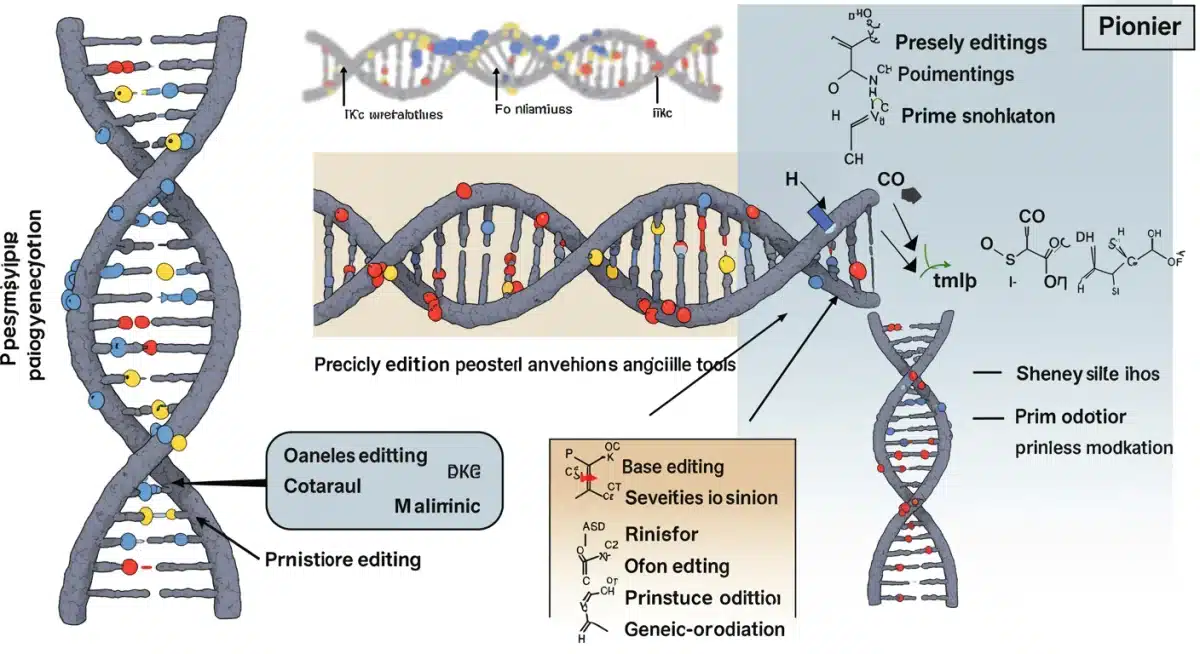
Base Editing represents a significant evolution beyond traditional CRISPR-Cas9, offering a more refined approach to gene modification. Instead of making double-stranded breaks in DNA, which can sometimes lead to unpredictable outcomes, base editors chemically convert one DNA base into another. This precision tool allows for single-letter changes in the genetic code without severing the DNA backbone, thereby reducing the risk of unwanted insertions or deletions.
This enhanced precision makes Base Editing particularly attractive for correcting point mutations, which are responsible for a vast number of genetic diseases. Its ability to directly rewrite specific bases offers a safer and potentially more efficient therapeutic strategy compared to methods that induce DNA breaks.

Advantages over traditional CRISPR
The primary advantage of Base Editing lies in its ability to achieve precise genetic corrections without the associated risks of double-strand breaks. This makes it a compelling option for conditions caused by single-nucleotide polymorphisms (SNPs), which are common in many genetic disorders. The reduced potential for off-target edits and chromosomal rearrangements positions Base Editing as a safer alternative for certain therapeutic applications.
- Minimizes unintended DNA alterations.
- Ideal for correcting single-point mutations.
- Potentially fewer adverse effects in clinical applications.
- Wider therapeutic window for certain genetic diseases.
Companies focusing on Base Editing technologies are attracting substantial investment, recognizing its potential to address a broad spectrum of genetic diseases with greater accuracy. The ongoing development of new base editor systems further enhances its versatility and therapeutic reach.
Ultimately, Base Editing symbolizes the next frontier in genetic precision. Its capacity to mend genetic errors with surgical accuracy offers a powerful tool for therapeutic development, making it a critical area for investors seeking innovative and de-risked gene editing solutions.
Prime Editing: The ‘Search and Replace’ of Genomics
Prime Editing is often heralded as the ‘search and replace’ function of gene editing, offering unparalleled versatility and precision. Developed by David Liu’s lab, this technology combines a reverse transcriptase enzyme with a modified guide RNA to directly write new genetic information into a target DNA site. Unlike CRISPR-Cas9, it doesn’t rely on double-strand breaks, and unlike Base Editing, it can insert or delete small sequences of DNA, in addition to making single-base changes.
This comprehensive capability means Prime Editing can correct a vast array of pathogenic mutations, including insertions, deletions, and all 12 possible point mutations, all without the need for a donor DNA template or creating double-strand breaks. Its broad applicability makes it a highly promising technology for a wide range of genetic disorders.
Broadening the therapeutic scope
The ability of Prime Editing to precisely insert or delete small DNA sequences positions it as a powerful tool for addressing complex genetic mutations that are beyond the reach of Base Editing or traditional CRISPR. This includes conditions caused by frameshift mutations or larger deletions, significantly broadening the therapeutic landscape for gene editing.
- Corrects all 12 types of point mutations.
- Enables precise insertions and deletions.
- Avoids double-strand DNA breaks, increasing safety.
- Addresses a wider spectrum of genetic diseases effectively.
Investment interest in Prime Editing is surging due to its potential to overcome many of the limitations of earlier gene-editing tools. Companies developing Prime Editing platforms are poised for substantial growth as the technology moves closer to clinical validation and commercialization. The ongoing optimization of prime editor delivery and efficiency will further solidify its position as a leading gene-editing modality.
To summarize, Prime Editing represents a leap forward in the sophistication and capability of gene editing. Its ‘search and replace’ functionality offers a comprehensive solution for genetic corrections, making it a cornerstone technology for the future of genomic medicine and a prime target for astute investors.
Investment Opportunities and Market Dynamics
The gene editing market is characterized by high growth potential, driven by technological advancements, increasing clinical applications, and a growing understanding of genetic diseases. For investors, navigating this dynamic landscape requires a keen eye on key players, intellectual property, and clinical trial progress. Identifying companies with strong foundational technology and robust pipelines is crucial for long-term success.
The market dynamics are also influenced by strategic partnerships, mergers, and acquisitions, as larger pharmaceutical companies seek to integrate cutting-edge gene editing capabilities into their portfolios. These activities can significantly impact stock valuations and create new investment opportunities.
Key players and emerging companies
Several established biotechnology firms are at the forefront of gene editing, including companies like CRISPR Therapeutics, Editas Medicine, and Intellia Therapeutics, all of which are actively developing CRISPR-based therapies. Beyond these pioneers, a new wave of companies is emerging, focusing on Base Editing and Prime Editing, such as Beam Therapeutics and Prime Medicine, respectively.
- CRISPR Therapeutics: Leading in CRISPR-based therapies for blood disorders.
- Beam Therapeutics: Innovating with Base Editing technology.
- Prime Medicine: Pioneering Prime Editing for diverse genetic corrections.
- Editas Medicine: Advancing CRISPR in ocular and other genetic diseases.
Investors should also consider the broader ecosystem, including companies involved in gene therapy delivery systems, bioinformatics, and manufacturing, as these are integral to the successful commercialization of gene-edited therapies. Diversifying investments across different aspects of the gene editing value chain can mitigate risk and enhance potential returns.
In conclusion, the investment landscape for gene editing is rich with opportunities, but also demands diligent research and a long-term perspective. Understanding the nuances of each technology and the strategic positioning of key companies will be essential for capitalizing on this transformative sector.
Challenges and Considerations for Investors
While the promise of gene editing is immense, investors must also be aware of the inherent challenges and risks associated with this rapidly evolving field. Regulatory hurdles, ethical considerations, and the technical complexities of developing and delivering gene therapies are significant factors that can impact investment outcomes. A balanced perspective, acknowledging both the potential and the pitfalls, is essential for making informed decisions.
The long development timelines for new drugs, coupled with the high costs of clinical trials, mean that profitability can be years away for many gene editing companies. Patience and a willingness to withstand market volatility are key attributes for investors in this sector.
Regulatory landscape and ethical debates
The regulatory environment for gene editing therapies is complex and varies by country, though the FDA in the United States is actively working to establish clear guidelines. The approval process for novel gene therapies is rigorous, focusing on safety, efficacy, and long-term outcomes. Any delays or setbacks in regulatory approval can significantly impact a company’s financial performance and investor confidence.
- Stringent FDA approval processes for gene therapies.
- Evolving international regulations and standards.
- Ethical considerations surrounding germline editing.
- Public perception and acceptance of genetic modifications.
Ethical debates surrounding gene editing, particularly germline editing which involves making heritable changes, continue to shape public opinion and policy. Companies must navigate these sensitive issues responsibly, ensuring transparency and adherence to ethical guidelines to maintain trust and support.
Ultimately, investing in gene editing requires a thorough understanding of not just the science, but also the regulatory, ethical, and market challenges. By carefully assessing these factors, investors can better position themselves to capitalize on the transformative potential of these technologies while mitigating associated risks.
| Key Technology | Brief Description |
|---|---|
| CRISPR-Cas9 | Pioneering gene editing tool, makes precise DNA cuts to modify genes. |
| Base Editing | Precise single-base changes without DNA breaks, ideal for point mutations. |
| Prime Editing | ‘Search and replace’ functionality for all mutation types, insertions, and deletions. |
| Market Outlook | High growth potential driven by tech advancements and expanding clinical applications. |
Frequently Asked Questions About Gene Editing Investment
The primary gene editing technologies poised for significant investment by mid-2026 include CRISPR-Cas9, known for its foundational role; Base Editing, which offers precise single-base changes; and Prime Editing, providing versatile ‘search and replace’ genetic modifications for a broader range of mutations.
Base Editing is an advancement because it corrects single-point mutations without creating double-stranded DNA breaks. This reduces the risk of unintended insertions or deletions, offering a safer and more precise approach for many genetic conditions compared to the double-strand cutting mechanism of traditional CRISPR.
Prime Editing offers unique benefits by enabling precise insertions, deletions, and all 12 types of point mutations without double-strand breaks or donor DNA. This ‘search and replace’ capability allows it to correct a far wider range of complex genetic errors than previous technologies, broadening therapeutic scope.
Investing in gene editing carries risks such as stringent regulatory hurdles, long and costly clinical trial timelines, potential off-target effects of the technologies, and ongoing ethical debates, particularly concerning germline editing. Market volatility and intellectual property disputes are also significant considerations for investors.
Promising gene editing companies often have strong intellectual property portfolios, robust clinical pipelines, clear therapeutic targets, and strategic partnerships. Investors should evaluate the specific technology platform, the expertise of the scientific team, and the company’s financial health to make informed decisions.
Conclusion: Navigating the Future of Biotech Investment
The gene editing landscape is undeniably one of the most exciting and rapidly evolving sectors in biotechnology. As we approach mid-2026, the advancements in CRISPR-Cas9, Base Editing, and Prime Editing present transformative opportunities for both patients and investors. These technologies are not merely incremental improvements; they represent fundamental shifts in our ability to address genetic diseases at their core. For those looking to invest, understanding the nuances of each platform, the market dynamics, and the inherent challenges is paramount. While the path to commercialization involves significant hurdles, the potential for groundbreaking therapies and substantial returns makes gene editing a compelling area for strategic investment. By staying informed and adopting a long-term perspective, investors can position themselves to be part of this revolution, shaping the future of medicine and reaping the rewards of innovation.