Leveraging AI for Drug Discovery: A 2026 Roadmap for US Biotech Startups to Cut R&D Time by 25%
The pharmaceutical industry stands on the cusp of a revolution, driven by the transformative power of Artificial Intelligence (AI). For US biotech startups, this isn’t just an opportunity; it’s an imperative. The traditional drug discovery pipeline is notoriously long, expensive, and fraught with high failure rates. From target identification to lead optimization and clinical trials, each stage demands immense resources and time. However, with the advent of advanced AI capabilities, the landscape is rapidly shifting. This article outlines a comprehensive 2026 roadmap for US biotech startups, detailing how to strategically integrate AI for drug discovery to achieve an ambitious yet achievable goal: cutting research and development (R&D) time by a remarkable 25%.
The journey of a new drug from concept to market typically spans 10-15 years and costs billions of dollars. This protracted timeline not only inflates costs but also delays life-saving treatments from reaching patients. AI offers a potent solution, promising to streamline processes, enhance accuracy, and accelerate discovery. By automating tasks, predicting molecular interactions with greater precision, and sifting through vast datasets, AI can significantly de-risk and expedite the drug development lifecycle. For agile biotech startups, embracing AI for drug discovery isn’t just about efficiency; it’s about gaining a crucial competitive edge in a fiercely competitive market.
The Current State of Drug Discovery: Challenges and Opportunities
Before delving into the roadmap, it’s crucial to understand the inherent challenges in conventional drug discovery. High attrition rates at various stages, particularly in preclinical and clinical trials, are a major hurdle. Many promising compounds fail due to lack of efficacy, toxicity, or unforeseen side effects. The sheer volume of biological and chemical data generated also presents a significant challenge; traditional methods struggle to extract meaningful insights from this data deluge. Furthermore, the iterative nature of experimental design and validation is time-consuming and resource-intensive.
This is where the opportunity for AI for drug discovery truly shines. AI algorithms excel at pattern recognition, predictive modeling, and data analysis at scales unimaginable for human researchers. They can identify novel drug targets, design de novo molecules with desired properties, predict compound toxicity, and even optimize clinical trial design. For US biotech startups, which often operate with leaner teams and tighter budgets than large pharmaceutical corporations, AI can democratize access to advanced R&D capabilities, leveling the playing field and fostering rapid innovation.
The global AI in drug discovery market is projected to grow substantially, indicating a clear trend towards AI adoption. Early movers, especially startups with flexible infrastructures, are best positioned to capitalize on this growth. By integrating AI for drug discovery strategically, these companies can not only reduce R&D timelines and costs but also develop more effective and safer drugs, leading to better patient outcomes and significant market share.
Pillar 1: Data Infrastructure and AI Platform Development (2024-2025)
The foundation of any successful AI for drug discovery initiative is robust data infrastructure. Without high-quality, well-organized data, even the most sophisticated AI models will falter. Biotech startups must prioritize building a scalable and secure data ecosystem. This involves consolidating diverse data sources – genomics, proteomics, metabolomics, clinical trial data, real-world evidence, and publicly available chemical libraries – into a unified, accessible format.
Phase 1.1: Data Acquisition and Curation
- Identify and Integrate Data Sources: Establish partnerships with academic institutions, contract research organizations (CROs), and data providers. Leverage open-source databases like PubChem, ChEMBL, and TCGA.
- Standardize Data Formats: Implement common data models and ontologies to ensure interoperability. This is critical for training machine learning models effectively.
- Data Cleaning and Annotation: Invest in automated and manual processes to clean, validate, and annotate data. Missing values, inconsistencies, and errors can severely impact AI model performance.
- Secure Data Storage: Utilize cloud-based solutions (AWS, Google Cloud, Azure) with robust security protocols to store sensitive biological and chemical data. Ensure compliance with regulations like HIPAA and GDPR, even for US-focused operations, as data sources can be global.
Phase 1.2: AI Platform Selection and Customization
- Choose a Core AI/ML Platform: Evaluate commercial AI platforms (e.g., Schrödinger, Insilico Medicine, Benchling) or build in-house solutions using open-source frameworks (TensorFlow, PyTorch). The choice depends on budget, internal expertise, and specific R&D needs.
- Develop Data Pipelines: Create automated pipelines for data ingestion, transformation, and feature engineering. This ensures a continuous flow of clean, relevant data to AI models.
- Establish an MLOps Framework: Implement Machine Learning Operations (MLOps) practices for managing the entire lifecycle of AI models – from development and training to deployment, monitoring, and retraining. This is crucial for maintaining model performance and scalability in AI for drug discovery.
- Compute Resources: Secure access to high-performance computing (HPC) or cloud-based GPU resources necessary for training complex deep learning models involved in AI for drug discovery.
Pillar 2: Strategic AI Application Across the Drug Discovery Pipeline (2025-2026)
Once the data infrastructure is in place, the focus shifts to strategically deploying AI for drug discovery at critical stages to maximize impact on R&D timelines.
Phase 2.1: Target Identification and Validation
Traditionally, identifying novel drug targets is a laborious process. AI can accelerate this significantly.
- Genomics and Proteomics Analysis: Use AI to analyze large-scale genomic and proteomic datasets to identify disease-associated genes, proteins, and pathways. Machine learning algorithms can predict novel therapeutic targets with higher confidence than traditional methods.
- Network Biology: Apply graph neural networks (GNNs) to model biological networks (protein-protein interactions, gene regulatory networks) to uncover central nodes or pathways that are critical for disease progression and amenable to drug intervention.
- Virtual Screening for Target Validation: Employ AI to predict the druggability of identified targets and assess their potential for off-target effects early on, reducing the number of targets pursued experimentally.
Phase 2.2: Lead Discovery and Optimization
This stage is ripe for AI innovation, where the goal is to find small molecules or biologics that bind to the target and optimize their properties.
- De Novo Drug Design: Generative AI models (e.g., GANs, VAEs) can design novel molecules from scratch with desired physicochemical and biological properties, bypassing the need to screen vast libraries. This is a game-changer for AI for drug discovery.
- Virtual High-Throughput Screening (vHTS): AI can rapidly screen millions of compounds against a target virtually, predicting binding affinity and efficacy, thereby drastically reducing the need for physical screening.
- ADMET Prediction: Predictive AI models can forecast absorption, distribution, metabolism, excretion, and toxicity (ADMET) properties of candidate molecules with high accuracy, eliminating compounds with poor pharmacokinetic profiles early in the process. This is a critical application of AI for drug discovery to save time and resources.
- Multi-objective Optimization: Use reinforcement learning or evolutionary algorithms to optimize multiple drug properties simultaneously (e.g., potency, selectivity, solubility, low toxicity), leading to more balanced and effective lead compounds.
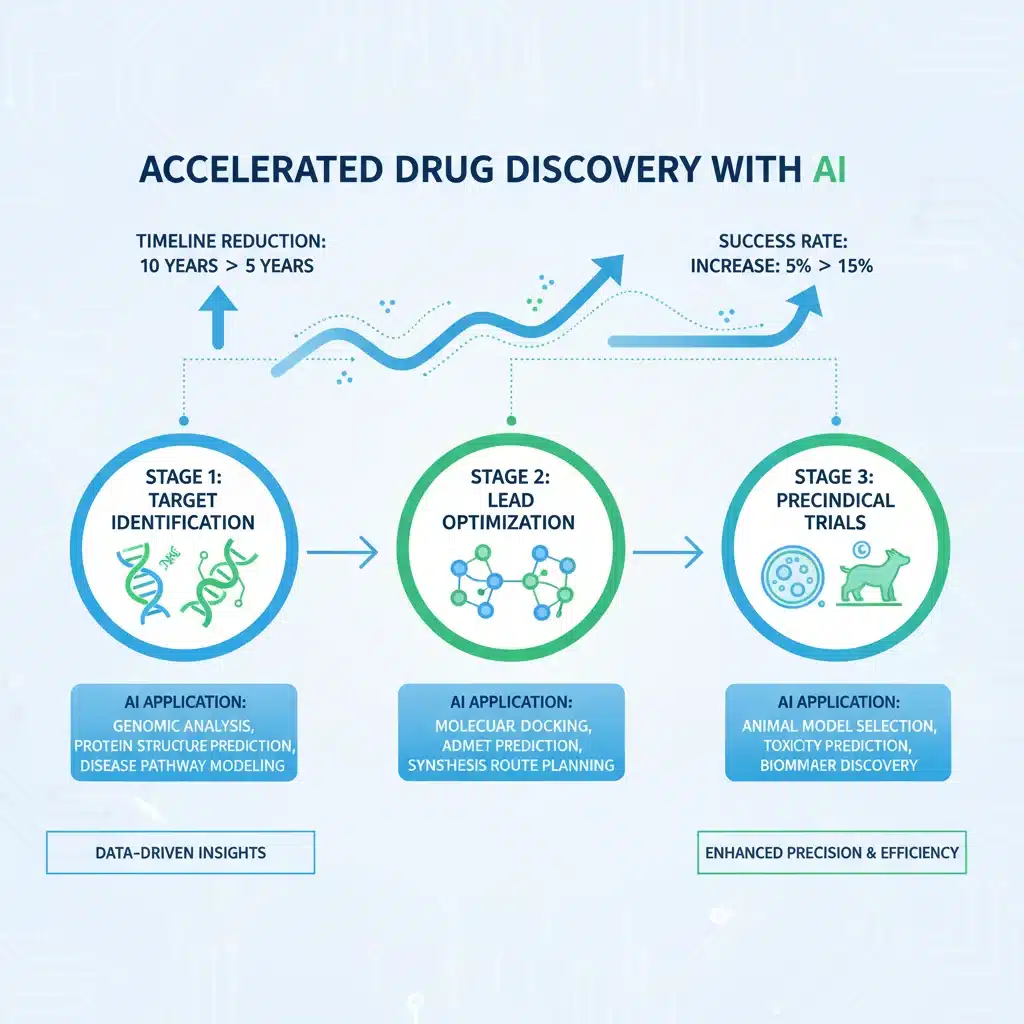
Phase 2.3: Preclinical Development and Translational Research
AI can also enhance preclinical studies and bridge the gap to clinical trials.
- In Silico Preclinical Models: Develop AI models to simulate drug efficacy and toxicity in virtual human systems, reducing the reliance on animal testing and accelerating candidate selection.
- Biomarker Discovery: AI can identify predictive biomarkers for drug response and toxicity from preclinical data, which can then be validated in clinical settings, enabling more precise patient stratification.
- Drug Repurposing: Apply AI to identify existing drugs that could be repurposed for new indications, significantly shortening the development timeline as safety data is already available. This is a swift win for AI for drug discovery.
Pillar 3: Building an AI-Driven Culture and Team (2024-2026)
Technology alone is insufficient. A successful AI for drug discovery strategy requires a skilled team and a supportive organizational culture.
Phase 3.1: Talent Acquisition and Training
- Recruit AI/ML Specialists: Hire data scientists, machine learning engineers, computational chemists, and bioinformaticians with expertise in AI for drug discovery.
- Upskill Existing Staff: Provide training programs for traditional biologists and chemists to understand AI principles and how to effectively collaborate with AI teams. Foster a hybrid skill set.
- Interdisciplinary Collaboration: Create cross-functional teams where AI experts, biologists, chemists, and clinicians work closely together from the outset. This ensures that AI solutions are biologically relevant and clinically meaningful.
Phase 3.2: Fostering an Innovation-Driven Culture
- Embrace Experimentation: Encourage a culture of rapid prototyping and iterative development. Not all AI models will succeed, but learning from failures is key.
- Data-Driven Decision Making: Promote the use of data and AI-generated insights at every stage of the drug discovery process.
- Ethical AI Framework: Establish guidelines for the ethical use of AI, particularly concerning data privacy, bias in algorithms, and transparency in model predictions.

Pillar 4: Strategic Partnerships and Funding (2024-2026)
Biotech startups rarely have all the resources in-house. Strategic partnerships and diversified funding are crucial for accelerating AI for drug discovery efforts.
Phase 4.1: Academic and Industry Collaborations
- Academic Research Collaborations: Partner with universities and research institutions renowned for AI and bioinformatics expertise. These collaborations can provide access to cutting-edge research, talent, and specialized datasets.
- CRO Partnerships: Engage with Contract Research Organizations that specialize in AI-driven drug discovery services. This can help augment internal capabilities without significant upfront investment in infrastructure.
- Cloud Provider Alliances: Partner with major cloud providers (e.g., AWS, Microsoft Azure, Google Cloud) for access to specialized AI/ML services, computing resources, and technical support.
Phase 4.2: Securing Funding for AI Initiatives
- Venture Capital: Target venture capital firms specializing in biotech and AI. Clearly articulate the value proposition of AI for drug discovery in reducing risk and accelerating time-to-market.
- Government Grants: Apply for grants from agencies like the National Institutes of Health (NIH) or DARPA, which often fund innovative technologies at the intersection of AI and life sciences.
- Strategic Investors: Seek investments from larger pharmaceutical companies looking to leverage AI capabilities through partnerships or acquisitions.
Measuring Success: KPIs for a 25% R&D Time Reduction
To achieve the ambitious goal of a 25% reduction in R&D time by 2026, clear Key Performance Indicators (KPIs) must be established and continuously monitored. For AI for drug discovery, these include:
- Reduced timelines at each discovery stage: Track the average time spent on target identification, lead generation, and preclinical testing compared to historical benchmarks.
- Increased hit-to-lead and lead-to-candidate conversion rates: AI should improve the quality of initial hits and leads, leading to a higher success rate as they progress through the pipeline.
- Decreased R&D costs per successful asset: By reducing failures and accelerating processes, the overall cost per drug should decrease.
- Number of novel targets/molecules identified by AI: Quantify the direct output of AI for drug discovery models.
- Accuracy and robustness of AI predictive models: Continuously validate model performance against experimental data.
- Time saved in experimental design and data analysis: Measure the efficiency gains from AI-driven automation.
Regular reporting and recalibration of strategies based on these KPIs will be essential to stay on track towards the 25% R&D time reduction target. The implementation of AI for drug discovery is not a one-time project but an ongoing process of optimization and adaptation.
Challenges and Mitigation Strategies for AI Drug Discovery
While the potential of AI for drug discovery is immense, startups must be prepared for challenges:
- Data Quality and Quantity: Ensuring sufficient, high-quality, and unbiased data remains a significant hurdle. Mitigation: Invest heavily in data curation, standardization, and explore synthetic data generation where appropriate.
- Interpretability of AI Models: ‘Black box’ AI models can be a concern in highly regulated environments. Mitigation: Prioritize explainable AI (XAI) techniques to understand model decisions and build trust.
- Integration with Existing Workflows: Seamlessly integrating new AI tools into established wet-lab and computational workflows can be complex. Mitigation: Adopt modular AI platforms and involve end-users in the development process from the beginning.
- Talent Gap: The demand for AI experts in biotech far outstrips supply. Mitigation: Focus on upskilling existing scientific staff, fostering interdisciplinary teams, and strategic outsourcing or partnerships.
- Regulatory Landscape: The regulatory framework for AI-driven drug discovery is still evolving. Mitigation: Engage with regulatory bodies, stay informed about guidelines, and build robust validation processes.
The Future of AI for Drug Discovery in Biotech Startups
Looking beyond 2026, the integration of AI for drug discovery will only deepen. We can anticipate:
- Autonomous Labs: AI-driven robots performing experiments, generating data, and feeding it back into AI models in a closed-loop system, further accelerating discovery.
- Digital Twins: Creation of virtual patient models to predict drug response and optimize personalized treatments, moving towards true precision medicine.
- Quantum Computing Integration: While nascent, quantum computing could eventually handle even more complex simulations and molecular modeling tasks, pushing the boundaries of what’s possible with AI for drug discovery.
- Federated Learning for Data Sharing: Securely sharing data across institutions without compromising privacy, enabling more robust AI models.
For US biotech startups, these advancements represent not just technological progress but a fundamental shift in how drugs are discovered and developed. By proactively adopting AI for drug discovery and following a strategic roadmap, these agile innovators can position themselves at the forefront of this transformation, delivering life-changing medicines to patients faster and more efficiently than ever before.
Conclusion
The 2026 roadmap for US biotech startups to cut R&D time by 25% through AI for drug discovery is ambitious but entirely feasible. It requires a multi-faceted approach encompassing robust data infrastructure, strategic AI application across the entire drug discovery pipeline, a strong AI-driven culture, and smart partnerships. By embracing these pillars, biotech startups can overcome the traditional hurdles of drug development, accelerate the delivery of innovative therapies, and secure a leading position in the future of medicine. The time to invest in AI for drug discovery is now.