AI Revolutionizes Biotech R&D: 30% Faster Drug Discovery by 2026

The landscape of biotechnology is undergoing a profound transformation, driven largely by the relentless march of artificial intelligence. In 2026, the ambitious goal of achieving a 30% faster drug discovery timeline, propelled by AI, is not just a pipe dream but a tangible reality shaping the future of healthcare. This article delves into the multifaceted impact of AI on biotech startup R&D, exploring the recent updates, the mechanisms behind this acceleration, and the challenges and opportunities that lie ahead for AI Biotech R&D.
For decades, drug discovery has been a notoriously lengthy, expensive, and often unpredictable process. From initial target identification to clinical trials and regulatory approval, the journey from concept to market can take over a decade and cost billions of dollars. This traditional model, while effective, has inherent inefficiencies that AI is now poised to dismantle. Biotech startups, unburdened by legacy systems and often driven by innovative spirit, are at the forefront of adopting these AI-driven methodologies, setting a new benchmark for accelerating R&D.
The promise of a 30% reduction in drug discovery timelines by 2026 is a bold statement, yet it’s one increasingly supported by advancements across various AI disciplines, including machine learning, deep learning, natural language processing, and computer vision. These technologies are not merely augmenting existing processes; they are fundamentally reshaping how research and development are conducted in the biotech sector. The focus on AI in Biotech Investing is intensifying, with significant investments pouring into startups that leverage these cutting-edge tools.
The Core Impact of AI on Drug Discovery Stages
AI’s influence permeates every stage of the drug discovery pipeline, offering unprecedented efficiency and accuracy. Understanding these specific applications is crucial to grasping the full scope of its transformative power.
Target Identification and Validation
Traditionally, identifying and validating biological targets for new drugs has been a laborious process, often relying on extensive literature reviews and experimental trials. AI, particularly machine learning algorithms, can analyze vast datasets – including genomics, proteomics, transcriptomics, and real-world patient data – to pinpoint potential disease targets with remarkable precision. These algorithms can identify subtle patterns and correlations that human researchers might miss, highlighting novel targets that are more likely to be efficacious and less prone to off-target effects. This significantly streamlines the initial, often bottlenecked, phase of drug discovery, making AI Drug Discovery more efficient from the outset.
Lead Compound Identification and Optimization
Once a target is identified, the next step involves finding compounds that can interact with it to produce a desired therapeutic effect. This is where AI truly shines in accelerating the process. Computational chemistry, powered by AI, can screen millions, even billions, of virtual compounds in a fraction of the time it would take for traditional high-throughput screening. Deep learning models can predict a compound’s binding affinity, pharmacokinetics, and toxicity profiles before it’s even synthesized. This virtual screening capability allows researchers to prioritize only the most promising candidates for experimental testing, drastically reducing the time and resources spent on synthesizing and testing ineffective molecules. Furthermore, AI can optimize lead compounds by suggesting structural modifications that improve potency, selectivity, and safety. This iterative optimization process, once a painstaking endeavor, becomes a rapid cycle of prediction and validation, directly contributing to the 30% faster drug discovery timeline.
Preclinical Development and Toxicity Prediction
Preclinical studies involve testing drug candidates in laboratory and animal models to assess their safety and efficacy before human trials. AI can significantly enhance this stage by improving the predictability of toxicity and adverse effects. Machine learning models, trained on extensive datasets of known drug-compound interactions and toxicity data, can forecast potential issues with higher accuracy than conventional methods. This not only reduces the number of animal tests required but also helps in identifying and de-risking candidates earlier in the development process, preventing costly failures in later stages. The ability to predict potential issues with greater foresight is a cornerstone of accelerated AI Biotech R&D.
Clinical Trial Design and Patient Selection
Clinical trials are the most time-consuming and expensive part of drug development. AI can optimize trial design by identifying optimal patient populations, predicting patient responses to therapies, and monitoring trial progress more effectively. Natural language processing (NLP) can analyze vast amounts of clinical literature and electronic health records to identify suitable patient cohorts, while machine learning can predict which patients are most likely to respond to a particular treatment, thereby increasing trial success rates and reducing recruitment times. This strategic application of AI is vital for achieving the ambitious goal of a 30% faster drug discovery timeline by 2026.
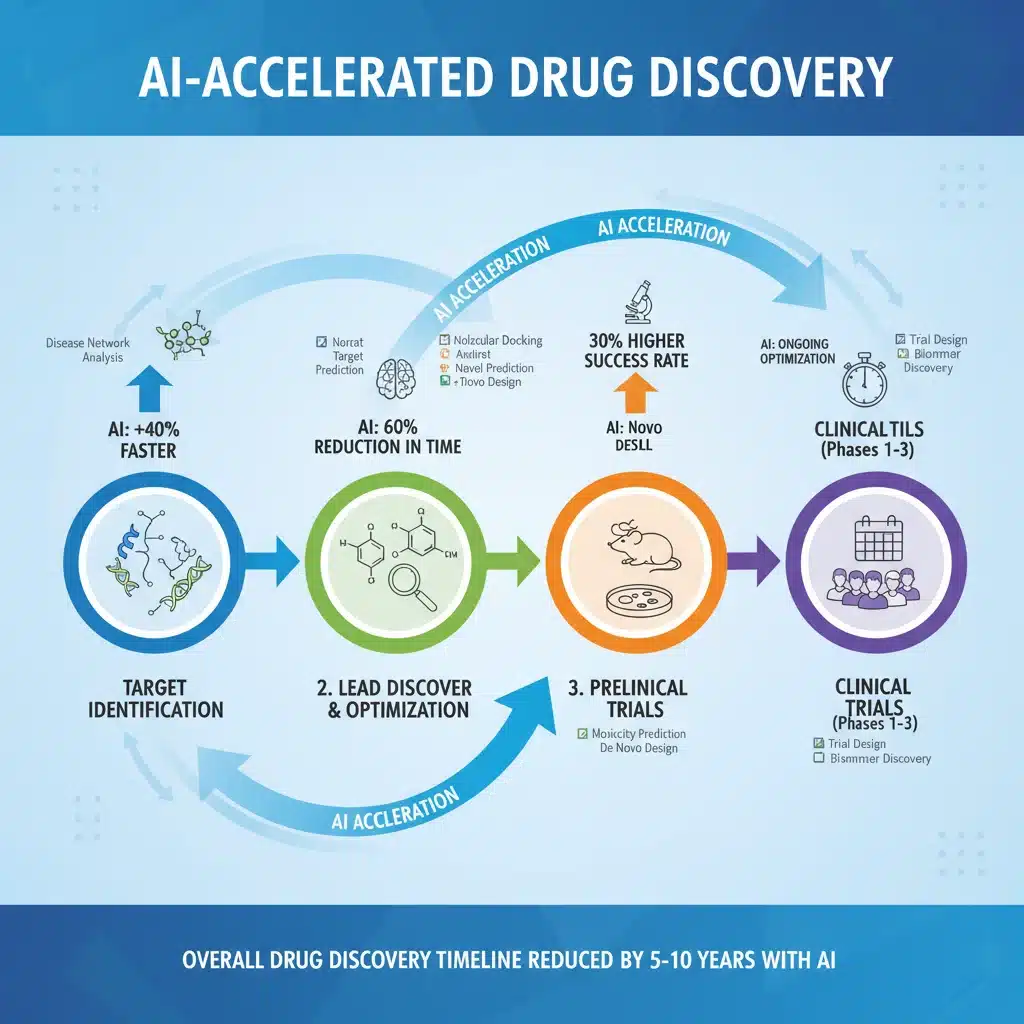
The integration of AI into these stages is not just about speed; it’s also about enhancing the quality and success rates of drug candidates. By leveraging AI, biotech startups can make more informed decisions, reduce attrition rates, and ultimately bring life-saving therapies to patients faster. This holistic approach to AI Biotech R&D is what sets the current era apart.
Recent Updates and Breakthroughs in AI Biotech R&D
The past few years have witnessed an explosion of innovation in AI applications for biotechnology. Several key areas stand out as drivers of the current acceleration.
Generative AI for Novel Molecule Design
One of the most exciting advancements is the use of generative AI models to design entirely novel molecules from scratch. Unlike traditional methods that screen existing libraries, generative models can propose new chemical structures with desired properties, such as specific binding affinities or pharmacokinetic profiles. This capability significantly expands the chemical space that can be explored, leading to the discovery of unprecedented therapeutic candidates. Companies are now using these models to design de novo drugs, moving beyond optimization to true innovation in drug design, a critical aspect of modern AI Biotech R&D.
AlphaFold and Protein Structure Prediction
DeepMind’s AlphaFold, and subsequent advancements, have revolutionized protein structure prediction. Understanding a protein’s 3D structure is fundamental to drug design, as it dictates how a drug will interact with its target. What once took years of experimental work can now be achieved in hours or even minutes with high accuracy using AI. This breakthrough has profound implications for accelerating target validation and lead optimization, allowing researchers to rapidly visualize and understand molecular interactions. The impact of such tools on shortening the overall drug discovery process cannot be overstated.
AI for Biomarker Discovery and Precision Medicine
AI is also playing a crucial role in biomarker discovery, which is essential for developing precision medicine approaches. By analyzing complex multi-omics data (genomics, proteomics, metabolomics), AI algorithms can identify specific biomarkers that predict disease progression, treatment response, or adverse drug reactions. This allows for the development of highly targeted therapies and personalized treatment plans, moving away from a ‘one-size-fits-all’ approach. For biotech startups, this means developing more effective drugs for specific patient populations, increasing the likelihood of clinical success and reducing development costs, further cementing the role of AI Biotech R&D.
Real-World Data (RWD) and Real-World Evidence (RWE) Synthesis
AI’s ability to process and derive insights from vast amounts of real-world data, including electronic health records, insurance claims, and patient registries, is transforming how drugs are evaluated post-market and even during development. RWD can provide valuable insights into drug efficacy and safety in diverse patient populations, supplementing traditional clinical trial data. This allows for continuous learning and adaptation, improving drug development strategies and potentially accelerating regulatory approval pathways. This data-driven approach is a hallmark of advanced AI Biotech R&D.
Challenges and Considerations for Biotech Startups
While the promise of AI in biotech R&D is immense, several challenges must be addressed for startups to fully harness its potential.
Data Quality and Accessibility
AI models are only as good as the data they are trained on. High-quality, well-annotated, and diverse datasets are essential for building robust and reliable AI systems. Biotech startups often face challenges in accessing large, clean datasets, especially for rare diseases or specific patient populations. Data silos, privacy concerns, and standardization issues can hinder the effective application of AI. Overcoming these data-related hurdles is paramount for successful AI Biotech R&D.
Computational Infrastructure and Expertise
Implementing advanced AI models requires significant computational resources and specialized expertise. Biotech startups need access to powerful computing clusters, cloud infrastructure, and a team of data scientists, AI engineers, and computational biologists. Attracting and retaining such talent in a competitive market can be a significant challenge. Building a strong foundation in computational genomics and bioinformatics is critical for any startup venturing into AI Biotech R&D.
Regulatory Landscape
The regulatory landscape for AI-driven drug discovery and development is still evolving. Regulatory bodies like the FDA are working to establish guidelines for the validation and approval of AI-powered tools and therapies. Biotech startups must navigate this evolving environment, ensuring their AI models are transparent, explainable, and rigorously validated to meet regulatory standards. Early engagement with regulators and adherence to best practices in AI development are crucial.
Ethical Implications and Bias
As AI becomes more integrated into healthcare, ethical considerations, such as algorithmic bias and data privacy, become increasingly important. AI models trained on biased datasets can perpetuate or even amplify existing health disparities. Biotech startups must prioritize ethical AI development, ensuring fairness, transparency, and accountability in their algorithms. Addressing these ethical concerns is not just a regulatory requirement but a moral imperative for responsible AI Biotech R&D.
Strategies for Biotech Startups to Leverage AI for Faster Drug Discovery
For biotech startups aiming to achieve a 30% faster drug discovery timeline by 2026, strategic implementation of AI is key. Here are actionable strategies:
Focus on Niche Areas with High Data Availability
Instead of tackling broad disease areas, startups can focus on niche indications where high-quality, relevant data is more readily available. This allows for the development of highly specialized AI models that can deliver significant impact within a concentrated area, demonstrating early success and attracting further investment. This targeted approach is often more feasible for startups in AI Biotech R&D.
Collaborate with Academia and Technology Giants
Partnerships can provide access to essential resources, expertise, and data that might be out of reach for a standalone startup. Collaborating with academic institutions can offer access to cutting-edge research and talent, while partnering with technology giants can provide computational infrastructure and advanced AI platforms. These collaborations can accelerate the learning curve and reduce the overhead associated with in-house development of AI Biotech R&D capabilities.
Develop Hybrid AI-Human Models
The most effective AI applications in biotech are often those that augment human intelligence rather than replace it. Developing hybrid models where AI handles data-intensive tasks and generates hypotheses, while human experts provide critical oversight, experimental validation, and clinical expertise, can lead to superior outcomes. This synergistic approach ensures the robustness and interpretability of AI-driven insights.
Invest in Explainable AI (XAI)
Given the regulatory and ethical considerations, investing in explainable AI (XAI) is crucial. XAI models can provide insights into how they arrive at their predictions, fostering trust and facilitating regulatory approval. For biotech startups, being able to explain the rationale behind an AI-generated drug candidate or a predicted clinical outcome can be a significant differentiator. This transparency is becoming increasingly important in AI Biotech R&D.
Prioritize Data Governance and Security
Robust data governance frameworks and stringent security measures are non-negotiable. Protecting sensitive patient data and proprietary research is paramount. Startups must implement best practices in data management, ensuring compliance with regulations like GDPR and HIPAA, and building a reputation for data integrity and trustworthiness. A strong data foundation is vital for sustainable AI Biotech R&D.

The Future Outlook: Beyond 2026
The 30% faster drug discovery timeline by 2026 is just the beginning. As AI technologies continue to mature and integrate more deeply into biotech, we can anticipate even more profound impacts. The future of AI Biotech R&D holds incredible promise:
- Autonomous Drug Discovery Labs: Imagine fully automated labs where AI designs, synthesizes, and tests compounds with minimal human intervention. This could drastically reduce discovery times and costs.
- Digital Twins for Personalized Medicine: Creating “digital twins” of patients – virtual models that simulate an individual’s biological response to different treatments – could revolutionize personalized medicine and clinical trials.
- AI-Powered Drug Repurposing: AI can efficiently identify existing drugs that could be repurposed for new indications, significantly shortening development timelines and reducing risk.
- Enhanced Biomanufacturing: AI will also optimize biomanufacturing processes, improving yield, quality, and consistency in the production of biologics and cell therapies.
The synergy between AI and biotechnology is creating an unprecedented era of innovation. Biotech startups, by embracing these technologies strategically and responsibly, are not just accelerating drug discovery; they are redefining what’s possible in healthcare. The journey towards a healthier future, powered by AI Drug Discovery Investment, is well underway.
The convergence of artificial intelligence and biotechnology is not merely an incremental improvement; it represents a paradigm shift. For biotech startups, the opportunity to leverage AI to accelerate R&D and achieve a 30% faster drug discovery timeline by 2026 is a compelling vision. While challenges persist, the strategic adoption of AI, coupled with robust data practices, collaborative partnerships, and a commitment to ethical considerations, will unlock unprecedented potential. The future of medicine is undoubtedly intelligent, and AI Biotech R&D is leading the charge.